This Summer, you have a bunch opportunities to view some of my work, both old and new!
At artspace this month through July 20, I have two pieces in the Suzanne Foley gallery. "Chainmail Warrior" and "Woodland Frolic" are featured in "The Fit and the Finish: size, surface and substance."
"Woodland Frolic," 2014, Sharpie and Acrylic on Canvas, 10x8 inches, $185
artspace, Zero E. 4th St., Richmond, VA 23224 (804-232-6464) - http://www.artspacegallery.org/
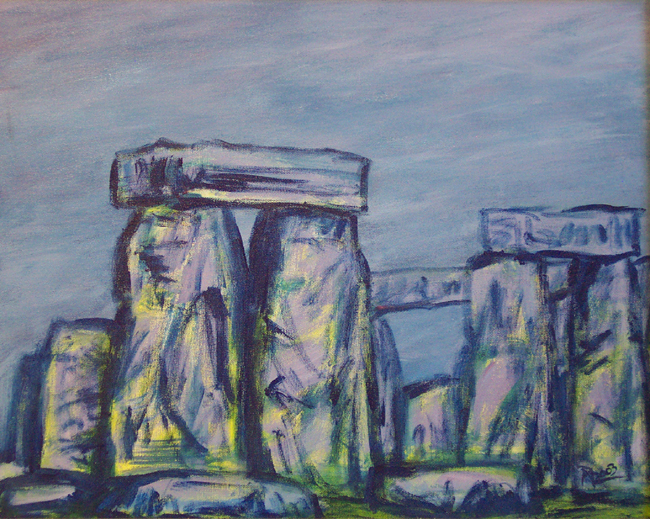
Through August 12, 2014, Glemore Yoga and Wellness Center, 10442 Ridgefield Parkway. Richmond, VA 23233 (804-741-5267) has several of my 2003 paintings of Stonehenge on view.
Stop by to see my work and check out their wonderful facilities! Visit: http://glenmoreyoga.com/
"Ancient Geometry," 2003, Acrylic on Canvas, 16x20 inches, $75
Through August 29, 2014, "Past-Present" at 9WG Studios, 9 W. Grace St., Richmond, VA 23220 (804-225-9510). The pieces being exhibited at 9WG during July and August, 2014, were
previously shown as a group at artspace, Zero E. 4th St., Richmond, VA
23224. The show titled "Altered Perceptions," was on view from March
23-April 22, 2012. This group of paintings have not been seen together
since that time. More info: http://9wgstudios.com/
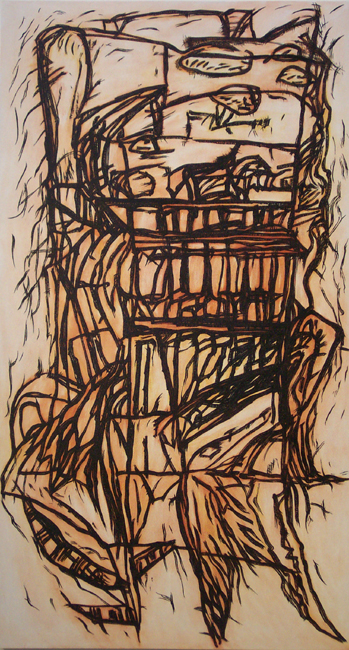
"White Elephant," 2011, Sharpie and Acrylic on Canvas, 60x48 inches, $3,500
In addition to these two venues, I have current work featured at Rawls' Museum Arts, 22376 Linden St., Courtland, VA 23837 (757-653-0754), and in two artspace Outreach shows. Included in the "2014
Rawls Juried Art Exhibit," juried by Nancy Kinzinger, are "Fragile Balance," "Feeding Frenzy," and "Perpetual Transit."
"Perpetual Transit," 2014, Sharpie and Acrylic on Canvas, 42x54 inches, $2,250
I have two pieces are on view at the Capital One, Chester campus in "artspace Speaks" through September, 2014: "Quantum Brew" and "Cetacean Camoflage."
"Quantum Brew," 2013, Sharpie and Acrylic on Canvas, 10x8 inches, $185
I also have two paintings at the Weinstein JCC, 5403 Monument Ave, Richmond, VA 23226 (804-545-8600) through the end of July:"Game Strategy" and "Operation Funnybone." More at: http://www.weinsteinjcc.org
"Game Strategy," 2013, Sharpie and Acrylic on Canvas, 11x14 inches, $200
I hate sharrow markings. They don't do anything except tell people what they should already know.
In the state of Virginia, bikes are allowed to ride on roads, except highways, with the same rules as cars. They are a waste of money and paint and they give some bikers the idea that they have special privileges in these lanes, potentially putting them at risk. Cars basically ignore them and many times they are placed in lanes that have parked cars in them.
Additionally, in areas where there are right turn only lanes, the sharrow puts bikers in the middle lane. This is due to a State law that says bikes can't travel in these lanes. But without a protected lane and some kind of signage, the biker is left to fend for themselves between lanes of traffic. Sometimes these turn only lanes are on/off ramps for highways. Motorists are typically much more aggressive when they have to deal with entering or exiting a highway.
To illustrate what I mean, here is a video I put together illustrating my commute on the Boulevard in Richmond, VA.
I've been working on 10 paintings recently that I began at the workshop I
held at the Visual Art Studio recently. I finished and signed 5 of them
last week. Still need titles, so if you have suggestions, let me know!!
The following five are close to being finished and some of them might be already, but they haven't been signed yet. All 10 pieces are 11x14 inches.
One of my favorite reasons to ride my bike is finding lost and abandoned items on the roadway. I find all sorts of crazy stuff! What I do with it depends on the situation. If the item is in the road and it looks useable, I will probably scoop it up and put it in my backpack. If it's too big, I will leave it, but have been known to return with a car to retrieve the item later.
I know I'm going to find something to do with this heavy duty plastic sheeting?! The roll is approx. 18 inches long.
The thing I find the most of is gloves. Most of the time gloves are lost singly. But a surprising amout of times, the pair is right next to eachother or just a few feet or yards apart. In the winter gloves are abundant as well as winter hats and scarves.
Winter cap (found under the I-95 Boulevard bridge)
After the Richmond Marathon every year I celebrate an annual harvest of forgotten articles at Bryan Park. One of the shorter races weaves through the back side of the park and many people leave behind stuff as they leave, likely never to return until next year at the earliest.
Adjustable wrench found last year some time
I don't pick up work gloves or gloves that are too messed up. I also avoid socks and underwear! But after washing everything thoroughly, I have plenty of warm stuff each winter for myself and to share with others.
These socks were an exception. They were on the road for about a month before I just had to bag them.
A few good things I've found recently
3 pieces of unbroken Pyrex and a Corning Ware casserole dish with top (found under the I-95 Boulevard bridge)
The cookware soaking in my studio utility sink.
I rode past this utility knife and had to come back to check it out.
It even has a good blade in it!
There are lots of things that look interesting, but if I don't know what it is, I probably won't pick it up.
I don't know what this thing is. But it looked important!
Reverse side of the important thingy. Found on the bridge over I-95 at Hermitage/Lakeside.
I have found silverware on numerous occasions.
This fork looked great until I picked it up and saw it was plastic!
I guess this fell out of someone's truck leaving the U-haul across from the Diamond.
Looks like it survived any damage. It was gone by the time I went home that night.
Looking out for stuff isn't just for my sake. Sometimes I find things that need to be returned. Twice I have found wallets and found a way to get them back to their owners. One time, I found a cane in the middle of the road. It had a name and phone number, so I called and left it at their residence. The other day, I found an unopened back of long grain white rice on the street, right next to a curb. I left it on the stairs of the house it was in front of.
Yes, I'm a scavenger, but I hate the idea of leaving good stuff to rot in the weather.
I'm planning on a new post about the things i find on my bike journeys soon, but in the meantime, here is a quick update on what's happening with my art.
I have two pieces selected for this month's juried all media show at Art Works, "Fragile Balance" and "Feeding Frenzy." "Feeding Frenzy" won 2nd place! They will be on view through April 20th in their upstairs gallery.
Also showing in Manchester, I have work in a group show in the Suzanne Foley gallery at artspace. This show also opens tonight and runs through April 20.
My show at the Visual Art Studio, "Into the Blue" continues through April 11. So that means you can find me there at the upcoming First Friday reception once again at 208 W. Broad St. New pieces that I started for the Workshop there on March 15th are progressing. Here's a few pics of what they look like now (plus one last piece that I started after that).
For a while now, I have been working on mixed media paintings that I call "Elaborate Doodles." When I tell people I call my paintings this, I get funny looks like "do you really want your work to be thought of as doodling?" Yes, I do want that. I think doodles are much more important than most people give them credit for.
Growing up, I was a good student and I think much of that was from my
doodling while taking notes in class. I am a visually oriented person and I think doodling on my notes gave
me a visual outlet to help cement and process the information I was
receiving - this idea is somewhat reenforced on a TED Talk video I saw last year
about the merits of doodling, by Sunni Brown.
Sunni Brown: Doodlers, unite
According to Sunni, the real definition of doodling is "to make spontaneous marks to help yourself think." She continues, "We think doodling is something you do when you lose focus but in reality it is a preemptive measure to stop you from losing focus." For me, doodling is even more than that. I think the act of doodling frees our mind from straining too hard for answers. It relaxes our thoughts, opening the mind to receive ideas or content from the our environment, both locally and universally. Frequently, these ideas will provide answers to questions that we may have been struggling to solve.
I figured out all of my most difficult projects and questions by first thinking as hard as I could about them for a day or so and then completely forgetting them. Making myself think about and do different things (in essence, life doodling) allowed my unconscious mind to cogitate on the details without my conscious mind getting in the way. There follows an "ah-ha!" moment where the details become instantly clear, somewhat like remembering an entire dream upon waking.
In the talk, Sunni expounds on her admiration for doodling, saying "under no circumstances should doodling be eradicated from a classroom or a boardroom or even the war room. On the contrary, doodling should be leveraged in precisely those situations where information density is very high and the need for processing that information is very high." She also says, "Because doodling is so universally accessible and it is not intimidating as an art form, it can be leveraged as a portal through which we move people into higher levels of visual literacy."
For much of my life, I produced mostly representational artwork, but I always felt like it was important for my paintings to help define themselves. Instead of trying to make a piece look exactly like the model, I wanted my mark to be visible and influenced by previous marks and colors. I found that the less I tried to control my tools, the more I was pleased with the results.
Around 2004, I started focusing on abstract paintings. These pieces were done entirely in brush work with no preliminary drawing. Then, in 2006, my buddy Browning and I were discussing the layout of a house I had lived in on Oregon Hill. I did a basic drawing of the floor plan and he put some marks on it to help clarify my responses to his questions. Soon after, I was looking at this sketch and it reminded me of some work I had done while I was studying at VCU in the 1980's. I was inspired to add to this drawing and ended up with the first of what was to become my "Elaborate Doodles."
"Untitled,"2006, sharpie on paper, 11x8.5 inches
For a time I was re-creating my original drawings into larger formats using conte crayon and oil paint on canvas.
"236,"2009, conte and oil on canvas, 64 x 35 inches
But I've always wanted to keep my paintings unique. Even though I wasn't making exact copies of the original drawings onto the paintings, I decided that I wanted the original drawing to be a part of the painting itself. Eventually, this process refined itself into the method that I currently use. Please note the images below are representative of each step, but they are all different pieces.
Creating an Elaborate Doodle
1. Draw first gesture lines - while lightly holding a sharpie, close eyes and do a loose gestural scribble, across as much of the canvas surface as possible.
Draw first gesture lines
2. Darken and define gesture lines - evaluate the gesture, join lines and go over lines with sharpie to create numerous segments of space.
Darken and define gesture lines
3. Add motion lines - using a (usually) thinner sharpie, draw repeated dashes in and across the segments of space.
Add motion lines
4. Add patterns to spaces - evaluate the drawing and allow your mind to see a pattern that is suggested by the motion lines in the segments of space. Fill in alternating spaces with first pattern then evaluate and choose another pattern or patterns for other segments of space. Turn drawing as needed to help see patterns and to decide which spaces they belong in.
Add patterns to spaces
Finish adding patterns to spaces
5. Paint washes of pigment - after the drawn patterns are finished, use paint washes in layers to accent or obscure the pattern-filled spaces.
Dark yellow wash over sharpie patterns
Light yellow and blue washes over sharpie patterns
6. Add final details - when the paint washes are dry, sharpie may be used to add detail or bring out lines that are obscured. Painted details may be added as well.
Light yellow, blue, and white washes over sharpie patterns and some details
The layers of sharpie and paint can be alternated at any time in the process as long as the paint is dry before trying to draw over it with sharpie. Sometimes, I begin with paint and then use the shapes that have developed from the wash to determine the line work in the piece. Other materials can be used if desired. I have worked some with pastels in addition to the sharpie and acrylic, but found them to be really hard on the life of the sharpies.
7. Name the piece - when no more areas of the painting appear to need work, spend some time evaluating the piece. Turn it as necessary until images and ideas begin to surface. Allow these images and ideas to play together until a title presents itself.
In "Cumuli Grazing" I see both clouds above and sheep grazing below
Elaborate Doodles are two-dimensional representations of multi-dimensional spaces and events. Lines and color are both physically and chronologically layered so that the piece becomes a record of time as well as space and mass. By allowing the painting to assist in its own creation, I feel that it is easier to access the stories, images, and memes that can be found in the universal well of creativity.